Why don’t commuters sing out loud on the train, even if they belt out Taylor Swift in the car? The answer says a lot about collaboration at work, and why behaviour is shaped less by intention than by the environment around us.

Introducing the Collaboration Maturity Model (CM2™)
Better collaboration takes more than good intentions.
Most people understand the value of collaboration. But asking teams to work together more effectively rarely changes what happens in practice.
Collaboration is shaped not only by people’s skills and attitudes, but by the structures, systems, relationships, routines, and expectations surrounding them.
Our Collaboration Maturity Model (CM2™) helps organisations understand these interconnected influences - and identify what needs to change to make collaboration easier, stronger, and more consistent.
Collaboration rarely breaks down because people do not care or are unwilling to contribute.
More often, capable and committed people are working within conditions that make collaboration unnecessarily difficult. Responsibilities overlap, information does not flow, competing priorities pull teams in different directions, and decisions are made without the right people involved.
Over time, the effects accumulate:
Improving collaboration requires more than addressing the visible friction. It means understanding what is producing it.
Introducing the Collaboration Maturity Model (CM2™)
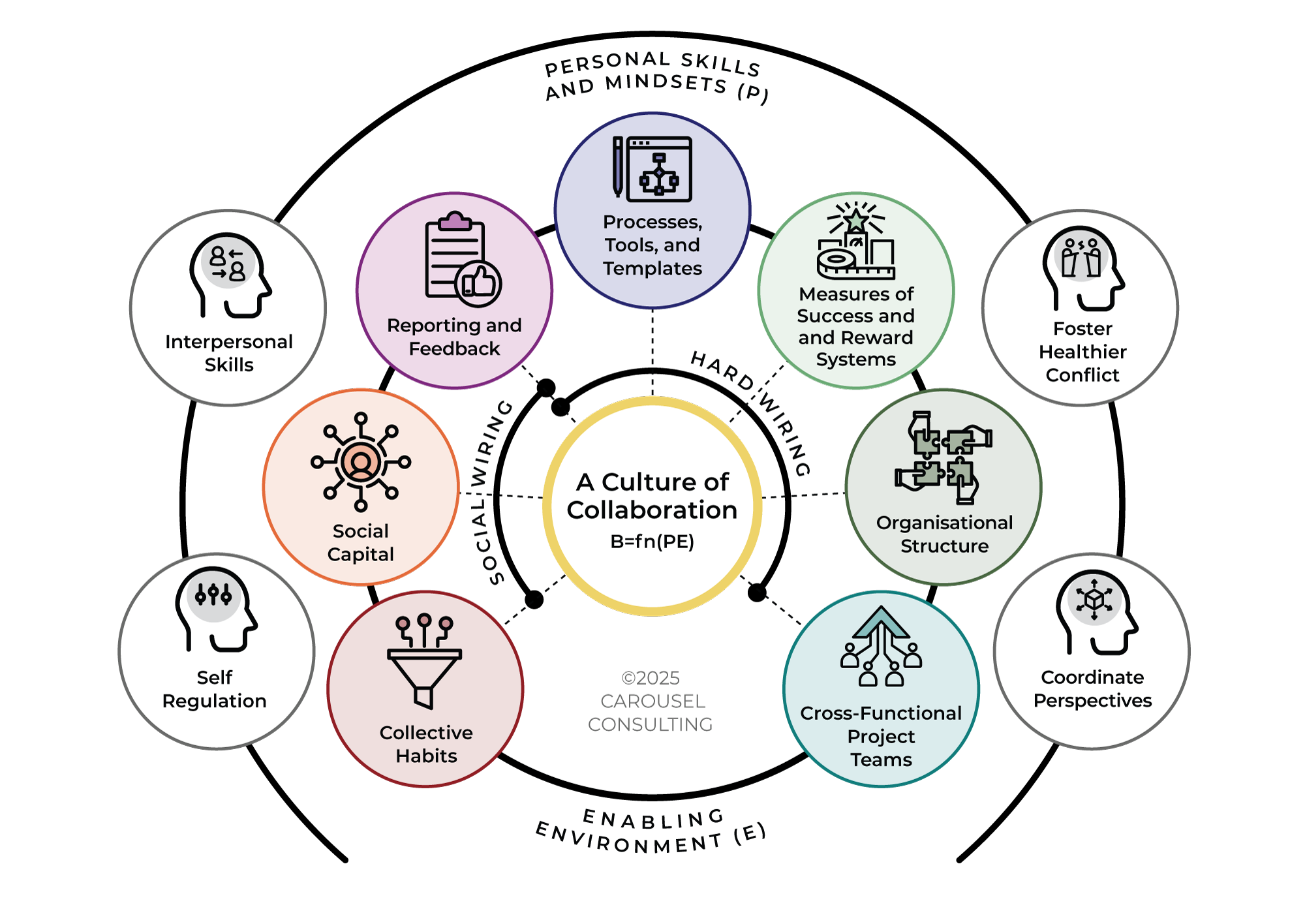
CM2™ is our proprietary framework for understanding and improving collaboration within and between teams, functions, organisations, and stakeholder groups.
It is grounded in organisational psychology and behavioural science, including Kurt Lewin’s principle that behaviour is shaped by the interaction between the person and their environment: B = f(P, E).
CM2™ applies this principle to collaboration by examining two interconnected dimensions.
- Personal skills and mindsets: The capabilities and perspectives people bring to collaborative work, including communication, openness, empathy, trust, constructive challenge, and willingness to consider different interests.
- The enabling environment: The organisational conditions surrounding people, including structures, systems, processes, leadership practices, incentives, decision rights, information flows, and established ways of working.
Neither dimension is sufficient on its own. Skilled collaborators will struggle in an environment that reinforces silos. Better systems will also have limited impact if people are not equipped or willing to work across boundaries.
CM2™ helps organisations understand both sides of the equation.
Designed for work that crosses boundaries.
CM2™ can be applied wherever people need to coordinate across different responsibilities, priorities, perspectives, or organisational contexts.
Between operational and corporate functions
Across regional and central teams
Within programs and working groups
Between leaders and operational teams
Across joint ventures and alliances
Within stakeholder and governance environments
CM2™ in practice.
Start with a clear diagnosis and a practical plan.
Our Collaboration Maturity Improvement Program applies CM2™ through a structured diagnostic and facilitated planning process.
In a matter of weeks, we help participating teams:
- Identify their collaboration strengths and barriers
- Agree on the priorities that matter most
- Develop a collectively owned strategy
- Create a practical roadmap and action plan for improving their collaboration maturity
Insights on collaboration.

Helping complex organisations understand and shift the human factors shaping performance, culture, leadership, collaboration, and change.
Carousel Consulting proudly operates on the traditional Country of the Jagera, Yuggera, and Ugarapul peoples. We respectfully pay our respects to Elders past and present, and recognise the continuing connection of Aboriginal and Torres Strait Islander peoples to Country, culture, and community. We are grateful for the enduring wisdom, care, and connection that continue to shape these lands.
EXPLORE
CONNECT
Or for thoughtful ideas on culture, leadership, collaboration, and change, sign up for our occasional newsletter
Or follow us on our socials
© Carousel HR Consulting Pty Ltd. All rights reserved.